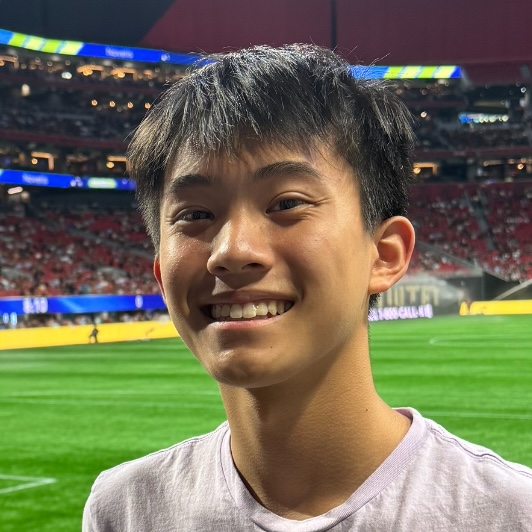
Hey! I'm Alex Wa, a 3rd year Math and CS major at Yale. I'm broadly interested in post-training methods including RL and OPD as well as alignment and interpretability.
Currently, I'm researching post-training efficiency algorithms with the MIT HAN Lab. Last summer, I interned with the model training team at Modal, working on RL. Previously, I've developed RL environments in Prime Intellect's RL Residency and worked with rubrics for agents at Judgment Labs.
In my free time, I draw, run The Veritas Search, play board games, and enjoy photography.
Posts
Learning MegaGem, from self-play to price discovery
We study MegaGem, a multi-player, general-sum, imperfect-information auction game developed by Jane Street, and train Qwen3-4B-Instruct to play it. SFT raises it’s elo rating from 551 to 1158, ahead of Claude Sonnet 4.6, Claude Opus 4.8, and GPT-5.5. Distilling an analytic expert raises it further to 1275, the highest rating in the benchmark and roughly equal with Gemini 3.1 Pro. (soon! we train a 750k parameter neural net via self-play to achieve near superhuman performance and comfortably beat every frontier model)
hunting for headroom on modded-nanoGPT (WR #82)
Modded-nanoGPT speedrunning is a popular benchmark that asks how fast 8xH100s can drive a 124M-parameter model to 3.28 validation loss on FineWeb. After iterating on dozens of failed experiments (mainly algorithmic including optimizers, activations, schedules), we propose a learnable per-(layer, head) $\tanh(\alpha)$ gate on Exclusive Self-Attention, broadened across all non-paired attention layers, which funds a 30-step schedule cut and brings the record down to 81.2 s (-0.6 s). Our submission PR is here.
frontier model training methodologies
How do labs train a frontier, multi-billion parameter model? We look towards seven open-weight frontier models: Hugging Face’s SmolLM3, Prime Intellect’s Intellect 3, Nous Research’s Hermes 4, OpenAI’s gpt-oss-120b, Moonshot’s Kimi K2, DeepSeek’s DeepSeek-R1, and Arcee’s Trinity series. This blog is an attempt at distilling the techniques, motivations, and considerations used to train their models with an emphasis on training methodology over infrastructure.
activation engineering for privacy protection in LLMs
LLMs trained on web-scale corpora inadvertently memorize and leak personally identifiable information (PII) present in their training data. We investigate inference-time interventions to suppress this privacy leakage. We evaluate three editing strategies: activation patching with computed steering vectors (APNEAP), random Gaussian noise steering, and Spectral Editing of Activations (SEA). Using the Enron email corpus with GPT-Neo-1.3B and finetuned Qwen3-8B-enron, we measure targeted PII suppression via exposure metrics like mean reciprocal rank (MRR), and utility via perplexity.
combinatorial reasoning environments for LLMs and RL
Can RL agents learn to play spatial reasoning puzzle games as well as, or better than, LLMs? We develop a complete RL pipeline by developing an environment for fruit box (a grid-based reasoning game) using Prime Intellect’s verifiers library, benchmarking LLMs like gpt-5.1 and gemini-3-pro, and training RL agents with SFT and GRPO to play. Repo here.
whirlwind of PPO and RLHF for LLMs from scratch
RLHF with PPO from scratch and lots of fine-tuning GPT-2 models for movie sentiment classification. Transformer environments, adapative KL control, logit/temperature scaling, whitening, and more. Full implementation here.